Keywords: autophagy, plants, cell fate, cell maintenance, genetics, molecular biology, cell molecular biology, genetic engineering, advanced microscopy, je suis GMO


I am interested in the molecular clockwork underlying most basic cellular mechanisms: cell differentiation, maintenance and its programmed death. Luckily, instead of spreading thin, I can focus my research on autophagy, which is implicated in virtually all aspects of cellular life. To add even more to its value, autophagy is an extremely interesting example of a mechanism conserved among almost all eukaryotes1,2 and shaped to fit different life strategies. 


Autophagy ensures sustainability of a eukaryotic cell. It recycles cellular content, keeping the cell functional and reducing its requirement for outsourced energy and nutrients. Upon activation of autophagy a fraction of cellular content is sequestered into a newly build double membrane vesicle, called autophagosome, and delivered to a lytic compartment for degradation. The products of degradation are then recycled by the cell3.


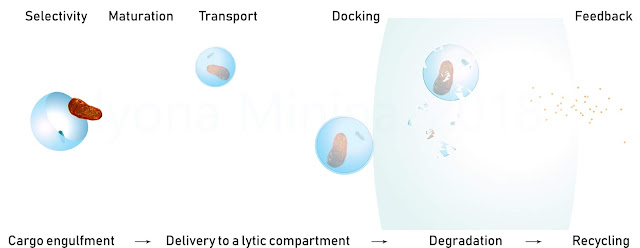


Autophagy can degrade individual molecules, complexes and even organelles. It is crucial for maintenance of long living cells in a functional shape and order, for removing unnecessary content during cell differentiation, for surviving starvation and other types of stresses. Despite the obvious importance of autophagy, surprisingly little is known about its mechanism in plants. I am interested in investigating molecular machinery of autophagy focusing on its plant-specific features.

Autophagosome formation in epidermal root cells of Arabidopsis thaliana. Alyona Minina, 2019.
Leica TCS SP5 confocal.

    
Dynamics of autophagy activity in Arabidopsis thaliana root
Alyona Minina, 2018. In collaboration with Alexis Maizel and Jazmin Reyes
Light-Sheet microscopy,MuVi SPIM Luxendo


What is the selectivity of plant autophagy under different stresses?

When autophagy is massively activated, it appears to degrade cytoplasmic content in “bulk”. It is not clear though, how a massive non-selective degradation of a cellular content might be helpful for survival under stress conditions. Emerging high-throughput studies performed on animal model systems indicate, that bulk autophagy is not that bulk after all4.


What are the mechanisms regulating maturation of plant autophagosomes? 

To be able to successfully engulf a cargo the membrane of a forming autophagosome must elongate and close on itself forming an outer and an inner membrane layer of a mature structure. We know close to nothing about the mechanisms regulating maturation of autophagosomes in plants. 


How are plant autophagosomes delivered to the lytic vacuole? 

Mature autophagomes containing cargo should be transported from the site of their formation to a lytic compartment. It is not known yet, what is the mechanism of autophagosome trafficking in plants. Furthermore, some studies indicate, that alternatively autophagosome might be targeted to the secretion pathway to help cell "spit out" the cargo5


How do plant autophagosomes recognize the membrane to fuse with? 

The outer membrane of a mature autophagosome should fuse with the membrane of a lytic compartment and avoid fusion with other membranous structures present in the cell. The mechanisms regulating plant autophagosome docking/fusion to/with the lytic vacuole are unknown. 


How are the products of degradation recycled by the cell? 

Plant lytic vacuoles are filled with proteases, lipases and nucleases capable of digesting the cargo  of autophagosomes into oligopeptides, nucleotides and fatty acids.  Very little is known yet about the role of vacuolar permeases in plant autophagy.


Posted by Alyona Minina on the 2017.03.04. Last updated on the 2018.11.05
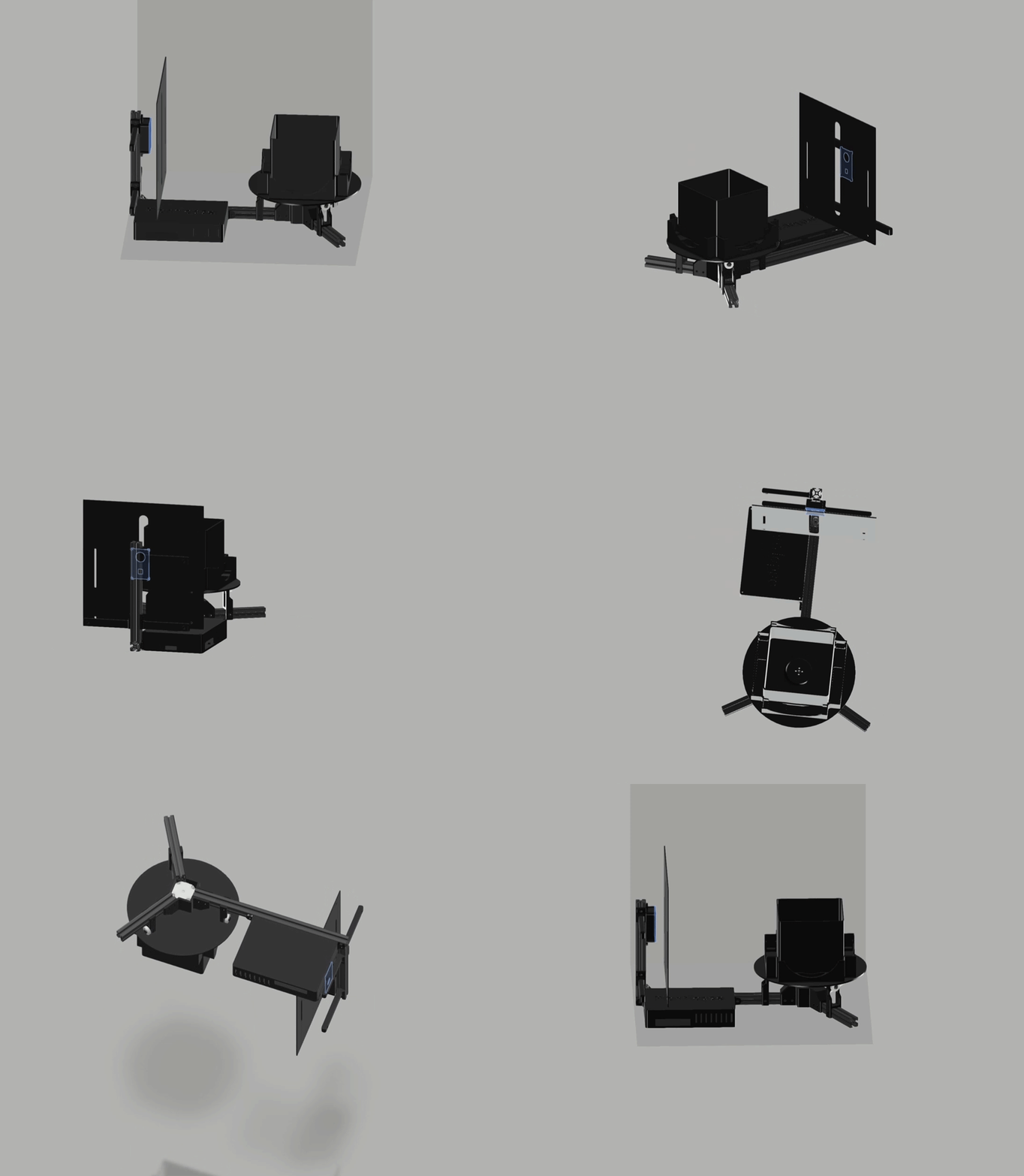
Robotic arm with a small foot-print

Master's degree/engineering course project

(The earliest starting date June 1st 2018. For more info contact Alyona)


 Fig. 1. Six days of time-lapse tracking of the root growth. Arabidopsis thaliana seedlings
 grown on a Petri dish in a plant growth chamber. 

The research in our group is focused on molecular mechanisms underpinning development of plants. It is similar to engineering when there is nobody around to explain you what all the parts are for. So, on daily basis, we break plant genes to see what they were needed for. To track plant growth properly we need a good camera system that will image plants for days or even weeks (exactly like Fig 1, but less blurry). We grow our plants in small Petri dishes within a growth cabinet and thus need the imaging platform to have small foot print.


Preliminary results:

We put together the minimal version of the imaging stage (see Fig. 2). Despite the questionable quality of the design, it was such a significant improvement of our experiments that we decided to invest into constructing a proper system. Our system is built around a Raspberry Pi computer, connected to a camera capable of producing images both under daylight conditions and at night using near-infrared illumination.
The growth cabinet
The imaging stage
Fig. 2. The current layout of the imaging stage.  The imaging takes place within the plant growth cabinet, which maintains optimal temperature and light intensity for the plants. Plants within a Petri dish are mounted on a Sugru holder and imaged by the IR camera taped to the piece of cardboard. The camera is plugged into a raspberry pi computer that saves images on a server connected via WiFi.


Our group has just installed a Prusa i3 MK3 3D printer!
In collaboration with JJ we will soon print our first prototype for time-lapse imaging  of 4 plates.

Fig. 3. Update (August 2018).  No more double-sided tape on cardboard! We are switching to 3D printing.


Project goals and requirements: 
1. Make the imaging stage less prone to falling apart. Additionally, the stage should be constructed in such a way that it provides more consistent images with regards to lighting.

2. Develop a small footprint robot that can move plates from the growth position to the imaging stage and back. This will enable parallel imaging of multiple plates, while not compromising the amount of light available to the plants.


3. The robot needs to be able to communicate with the Raspberry Pi, either via ethernet, WiFi, bluetooth or serial/GPIO (or you may have other suggestions). 


Why should you join us:

Fig 3. The team.
1. You will work in a fantastic team (see Fig. 3). We love what we do, and call it "work" just because we get paid for it.

2.  You will co-author an open access publication describing the hardware and software of the system, helping other scientists to build on what we develop. All blueprints and software packages will be made available on-line under a permissible open source license.

3. We will introduce you to engineering on the DNA level.


Time-resolving the dynamics of plant autophagy molecular machinery.


PhD position in Biology. Plant Cell and Molecular Biology.


Department of Molecular Sciences, SLU, Sweden


Work environment
Swedish Agricultural University (SLU) is one of the highly-ranked universities world-wide. The department of Molecular Sciences belongs to the NJ-faculty and is located at the Uppsala BioCenter, Ultuna campus of SLU.  Our department is a vivid, multicultural workplace employing over a hundred researches with a very broad range of expertise including nanotechnology, inorganic and organic chemistry, structural biology, food science, microbiology, plant biochemistry and cell molecular biology. The department hosts or is responsible for outstanding facilities for protein crystallography, chromatography, bioreactor, NMR, mass spectrometry, advanced microscopy: AFM, SEM, confocal microscopy and contributes to the development and use of the Max IV synchrotron. The department provides a nourishing environment for establishing new transitional research. The doctoral student will be working in a young research group interested in plant autophagy


The project
We are looking for a highly motivated doctoral student to join us in investigating regulation mechanisms of plant autophagy.

Green, GFP-tagged autophagosomal marker in epidermal cells
 of Arabidopsis cotyledon under normal conditions. Red,
autofluorescence of chlorophyll.  Alyona Minina, unpublished.
3D reconstruction of autophagy marker detected in Arabidopsis
 root (the signal is color coded for depth).
Alyona Minina, unpublished.
Autophagy is the major catabolic process of eukatyotic cells, its molecular machinery is highly conserved and is controlled by the so called autophagy-related (ATG) genes. Autophagy is implicated in developmental processes and stress responses in all eukaryotes including plants. Plant autophagy is important for drought and salt stress tolerance, plant-pathogen interactions, fecundity and longevity of the plant (1, 2). In our previous studies we demonstrated that artificial up-regulation of autophagy has an invigorating effect on plant performance (3, 4). Despite the obvious importance of plant autophagy, little is known about the dynamics of this process. In this project the doctoral student will perform a detailed time-resolved in planta analysis of autophagic response to a short and prolonged stress, focusing on duration of the transcriptional and post-translational signaling. The PhD student will use forward and reverse genetics tools, build on the systems for in vivo autophagy detection developed in our group, analyse changes in the transcriptome dynamics, use advanced fluorescent microscopy and molecular biology tools to thoroughly characterize the chain of events activating and modulating plant autophagy response to various stress conditions. The knowledge obtained in this project will be an extremely important contribution to our understanding of plant autophagy.
Furthermore, the doctoral student will have a unique opportunity to  collaborate with the SweTree Technologies AB to test applicability of our proof of concept results on the crop tree species. 


Our selected publications most relevant to the project
Minina et al., 2018. JXB
Avin-Wittenberg et al., 2018. JXB
Minina et al., 2017. New Phyt
Minina et al., 2014. Trends in Plant Sci
Minina et al., 2013. JCB
Minina et al., 2013. Aging Cell


Education 
The department is an organizing participant of two graduate schools, providing access to a broad range of advanced courses on genetics, bioinformatics, cell and molecular biology, biochemistry, advanced microscopy, structural biology, statistics, teaching in higher education, career development, writing scientific publications etc.
As a part of the project, the doctorate student will receive an advanced personal training in the methods relevant for the project by the experts in our group and by our collaborators.


Qualifications
The successful candidate must have basic eligibility for third cycle education, i.e. she/he has taken a second cycle qualification or has completed course requirements of at least 240 higher education credits, including at least 60 higher education credits at the second cycle education and holds a Master's degree in biology or similar.

The candidate must be highly motivated, interested in working in a multicultural environment, be fluent in spoken and written English (upper secondary school grades equivalent to English B/English 6). Experience with molecular biology, basic knowledge of statistics and bioinformatics are required, experience with Arabidopsis thaliana model organism is a benefit.


Employment
Four years of full-time employment as a doctoral student at SLU. Additionally, the employment will be prolonged to compensate for the doctoral students' time spent on teaching at the department (up to 20% of the planned 4 years).


Supervision
Main supervisor:  Alyona Minina (E.A. Minina)
Co-supervisor:     Peter Bozhkov


Starting date
January 10th, 2019 or later (the date is negotiable)


SLU is an Equal Opportunity Employer
Read about the PhD education at the NJ faculty of SLU here
Selection among applicants meeting the requirements is made with reference to written application including curriculum vitae, copies of degrees and transcripts of academic records, one copy of the dissertation for masters or undergraduate degree, a list of at least two references familiar with the applicant's qualifications, certified knowledge of the English language and an interview.


How to apply
Please follow this link, scroll down to the bottom of the page and click on the button "Apply". Sign up using your email address and fill in the application form.
The application must be submitted no later than 2018.10.30. Incomplete applications or applications submitted after the deadline will not be considered.


Academic union representatives
Contact info here.

Master's degree project in plant genetic engineering. 

Available earliest from the September 20th 2018.


Contact:
 Alyona Minina, PhD: alena.minina (@) slu.se
 Anna Åsman, PhD: anna.asman (@) slu.se


In our group we are currently focusing on investigating the molecular machinery of plant autophagy. We are looking for a highly motivated student who is interested in  joining our group to optimize CRISPR-Cas9 system for knock-in modification of plant genes. 

An example of CRISPR-Cas9 driven knock-in.
A stop codon of a gene in Arabidopsis genome
is replaced with a DNA sequence encoding the
Green Fluorescent Protein (GFP). The resulting
plant expresses a GFP fusion of the endogenous
protein.

Most of the current plant molecular biology studies still rely on the use of crude genetic engineering tools that dramatically limit the capacity of our research. The recent advances in the use of CRISPR-Cas9 system for plants give very promising results that still require some significant modifications. 


In this project we aim to optimize the CRISPR-Cas9 for precise knock-in modification of Arabidopsis genes and use the new tool to make reporter lines for detection of plant autophagy-related (ATG) genes activity. 


This project, in general, will open up a broad range of new possibilities for investigating plant gene function and in particular, will make a significant contribution to our understanding of ATG-genes regulation.  


Project goals
  1. Establish proof of concept constructs for knock-in modification of Arabidopsis thaliana genes in protoplasts
  2. Create a set of constructs for knock-in modification of genes important for regulation of autophagy in Arabidopsis thaliana
  3.  Participate in establishing transgenic lines by knocking in green fluorescent protein and luciferases into Arabidopsis genome


You will acquire skills in
  1. Genetic engineering
  2. Use of CRISPR-Cas9 in plants
  3. Advanced DNA and protein molecular biology methods
  4. Advanced confocal microscopy
  5. Plant transformation
  6. Handling typical plant model organisms: Arabidopsis thaliana plants and tobacco cell cultures


Seed Plating Robot

15 HEC Engineering project


Background

Our group works with a plant model organism called Arabidopsis thaliana. For some of our projects we image seeds of Arabidopsis placed on the top of agar-containing medium in Petri dishes. Putting seeds on plates is a boring and tedious task and we want to develop a robot that could do it for us. The robot should be able to plate seeds on two types of Petri dishes (round, ⌀ 9 cm dishes containing 25 ml of the agar-containing medium, square 12x12 cm Petri dishes containing 50 ml of the agar-containing medium). Ultimately, we would like to publish the results of this project.


Figure 1. Suggested design, any modifications/optimizations and alternative designs are most welcome.
A. Suggested design. 1. Indentation in the stage to accommodate 9 cm round Petri dishes. 2. Indentation in the stage to accommodate 12x12 cm square Petri dishes. 3. Holders for 1.5 and 2 ml eppendorf tubes containing seed stocks. 4. Holders for sterile disposable tips. 5. Dispensing head that can transfer a single seed from a stock on a designated place onto a plate. 6-8. Movement in three dimensions should be designed to minimize the robots footprint and possible contamination of the medium on the plates. B. Suggested grid layout for coordinating seed transfer on plates.  Please note, that it is important to introduce asymmetry (one extra seed? A dot-like scratch on the medium?) to denote the left top corner. C. Seeds transferred on the plates will be later imaged using our PetriPi robot, images will be processed using automated image analysis. Seeds will germinate and roots will grow gravitropically, thus there should be at least 2 cm distance from a seed row to the bottom rim of a plate.


Hardware to be developed in this project

  • Smallest possible footprint robot that can transfer seeds from the stocks in 1.5 or 2 mL eppendorf tubes onto plates.
  • Seed plating must be done under sterile conditions (in a Fortuna Clean Bench), thus robot parts have to be autoclavable (120 ᵒ C), resistant to 70% Ethanol and not shedding particles on open plates
  • Seeds must be put on the surface of the medium. For automated analysis of images it is important that there are no damages on the agar around the plated seed. Seeds can be dispensed while being dry (please note, that dry seeds are more difficult to handle due to static electricity) or they can be suspended in sterile water. If needed, the robot can be connected to vacuum supply, alternatively, we can also provide an old Gilson pipette that can be used to pipette a fixed volume and discard tips.
  • Seeds should be plated in rows, with at least 3 mm distance between the seeds and at least 2 cm vertical distance between the rows. There should be asymmetry in the plating pattern that will allow to identify left top corner. Optimally it would be great to develop a robot that will confirm successful plating of a seed before proceeding to the next.
  • Stocks should not be contaminated with seeds that don’t belong to them, thus it is desirable to use disposable tips for the seed dispenser. These can be custom-designed, alternatively there are commercially available filter tips (we can provide samples).
  • The minimal number of seed to be plated from each stock = 4. Thus it can be used as a single input unit, when user defines coordinates for plating.
  • The stage should enable fixed positioning of two types of plates.
  • Plating time must not exceed 40 minutes, as it will lead to drying the medium.


Software to be developed in this project

  • The area of Petri dishes should be split into a grid. Single input unit for plating (e.g position A1 on the Fig1B.) should correspond to positioning 4 seeds from one stock.
  • User should be able to define seeds from what stock should be plated into which square
  • The robot can be controlled via any method that is sufficiently user friendly, e.g. Ethernet connection to user’s compute, SD card, USB stick
  • Software should predict the time required for plating. An optional feature would be to also notify the user that plating is complete.
  • The software must be open-source


Facility
  • Prusa i3 MK3 3D printer is readily available in our group
  • All running costs will be covered by our group. Please provide us with invoices!


Grading
  • All hardware and software developed in this project should be available to our group
  • A comprehensive report should be provided by the end of the project.
  • Top grade: the robot transfers more than 90% of seeds from a single stock on two types of plates from at least two stocks
  • Medium grade: the robot transfers at least 90% of seeds on two types of plates from a single stocks
  • Low grade: the robot transfers some seeds from a single stock


Main supervisor:
  • Pernilla Elander, PhD student, Dept. of Mol Sci, SLU e-mail: pernilla.elander (at) slu.se


Co-supervisors:
  • Jonas Ohlsson, PhD student, Dept. of Mol Sci, SLU e-mail: jonas.ohlsson (at) slu.se
  • Alyona Minina, Ass. Prof.,  Dept. of Mol Sci, SLU e-mail: alena.minina (at) slu.se
Master's degree project in plant cell molecular biology

Available earliest  March 1st 2019. 

Contact:
Alyona Minina, PhD: alyona.minina(at)slu.se
Adrian Dauphinee, PhD: adrian.dauphinee(at)slu.se


Flyer

Detection of autophagy activity changes
 in epidermal root cells of Arabidopsis thaliana


Autophagy is the major catabolic process of eukaryotes allowing cells to recycle their own contents. It is intensively investigated by plant biologists to elucidate mechanisms regulating plant fitness and stress tolerance. Development of precise molecular tools to study plant autophagy is a difficult but an extremely important task.


In this project we aim to study in details the effects of a drug typically used to modulate autophagy in plant cells. The project is based on strong preliminary data indicating that the effect of the drug might be much more complex than usually assumed.


Project goals:
  1. Quantification of successive changes in autophagy activity during the drug treatment using advanced fluorescent microscopy and biochemistry methods
  2. Investigating activity of potential off-targets of the drug
  3. Optimization of the drug concentration and treatment duration for minimizing possible side effects


 You will acquire skills in:
  1. Advanced fluorescent microscopy 
  2. Handling typical plant model organism Arabidopsis thaliana 
  3. Advanced DNA and protein molecular biology methods 
  4. Genetic engineering

Posted by Alyona Minina on the 2018.11.06.

Master's degree project in plant cell molecular biology

COS, Heidelberg University, Germany
Available earliest from the February 1st 2019. 

Contact:
Alyona Minina, PhD: alyona.minina (@) cos.uni-heidelberg.de
Jana Askani, MSc: jana.askani (@) cos.uni-heidelberg.de
Karin Schumacher, Prof:  karin.schumacher (@) cos.uni-heidelberg.de

Flyer

Autophagy is the major catabolic process underpinning sustainability of eukaryotic cells. It is the process by which cells engulf cargo destined for degradation into double-membrane vesicles, autophagosomes, deliver them to a lytic compartment (vacuole) and upcycle the products of degradation.


Tracking autophagosomes in epidermal root cells of Arabidopsis thaliana.


Elucidating the molecular machinery of plant autophagy enables understanding of how plants cope with biotic and abiotic stresses and contributes to our knowledge of plant developmental programs.
In our group we combine a unique expertise in plant vacuole biogenesis, endomembrane trafficking and autophagy. In this project we are going to investigate key steps of plant autophagosomes maturation prior to their fusion with the vacuole.


 Project goals:

  1. Establishing a set of transgenic lines expressing mutant forms of proteins required for plant autophagosomes maturation
  2. Detecting dynamics of autophagy efficacy in the established lines
  3. Planning and making genetic constructs for further mutations to elucidate the maturation mechanism in more details


 You will acquire skills in:
  1. Advanced fluorescent microscopy 
  2. Handling typical plant model organism Arabidopsis thaliana 
  3. Genetic engineering 
  4. Advanced DNA and protein molecular biology methods 
  5. Plant transformation 


Posted by Alyona Minina on the 2018.11.06.